
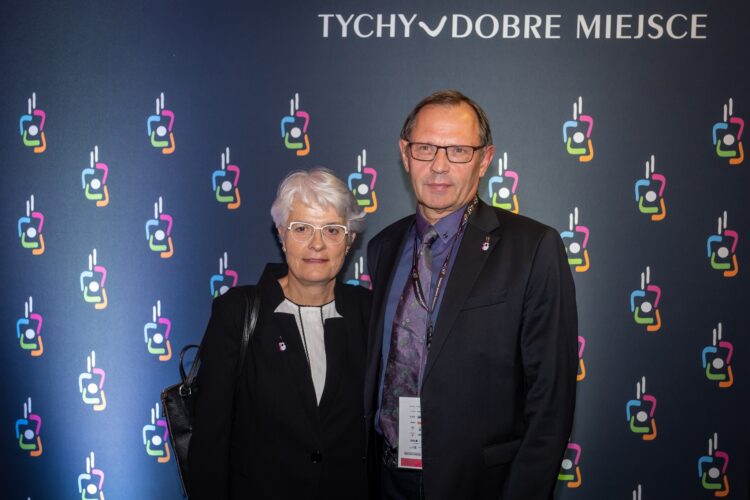
A MAN OF MANY PASSIONS
We were counting down the days until our next meeting with him. We were expecting to see his kind, smiling face in October, during the 19th International Silesian Guitar Autumn Festival in Tychy. However, we did not expect the news which came a few months before the inauguration of the festival. On 29 June 2024, Romuald Jurkowski passed away.
Swimming and Judo
Although Romek was born (on 3 December 1955) in Baranowicze, a town once located in Poland but now within the borders of Belarus, he spent almost his entire childhood and early youth in Tychy, where his parents had settled. After attending primary schools No. 12 and 17 in Tychy, he decided to continue his education at Liceum Ogólnokształcące im. Marii Konopnickiej (Maria Konopnicka Secondary School) in Katowice. Although his father, Jan Edmund Jurkowski, was an artist: a musician, composer, and lecturer at the Karol Szymanowski Academy of Music in Katowice, Romek chose the mathematics and physics class because he felt more comfortable with the sciences. “He started each day with a morning workout at the pool of the Youth Palace,” recalls Anna, Romek’s sister. “This was his first passion: swimming and involvement in the Volunteer Water Rescue Service (WOPR). This involved frequent training sessions at swimming pools and at Goczałkowice Lake, as well as participation in many competitions. While in France, he extended that passion to his children and grandchildren,” adds Anna.
Another one was… judo, which he began practising while studying at the Faculty of Mechanical and Energy Engineering at Warsaw University of Technology. At that time, he also developed an interest in literature, philosophy, and foreign languages (he was improving his English and French, and spoke Russian fluently). Finally, the paternal genes came into play, leading Romek to a deeper interest in classical music. He especially liked and appreciated the works of Chopin, Rachmaninoff, Schubert, and Liszt.
Work, Piano, Skiing, and Golf
In 1981, in Warsaw, he met Marie-Madeleine, whom he later referred to and introduced as Magda. The following year brought a wedding and the decision to settle in France. First, they lived in Bretagne, Magda’s region of origin, and then in Nancy, where Romek undertook a three-year programme at the École Nationale Supérieure des Industries Chimiques, which culminated in a doctorate. Then they settled for twenty years in Culoz, in the Ain department, in the Auvergne-Rhône-Alpes region. Romek was employed as a research engineer at the Compagnie Industrielle d’Applications Thermiques, a French company manufacturing refrigeration machinery and heat pumps.
“In his mature years, he returned to playing the piano, which we both had learnt from early childhood,” recalls his sister Anna. “Wanting to instil a love of music in their children, Romek and his wife purchased a piano, which also allowed him to actively develop his passion for piano music. He always admired the virtuosos of this instrument and, in his spare time, persistently practised the most challenging passages of his favourite pieces, such as the Heroic Polonaise by Chopin and the Flight of the Bumblebee by Rimsky-Korsakov. He also enjoyed Irish music, especially as performed by the band The Chieftains,” she adds.
Ania does not forget about her brother’s other sports passions. “Having lived in France since the age of 27, he expanded his sporting passion to include new disciplines. In winter, he loved to go cross-country skiing in the mountainous region where he lived, or in Briançon in the Alps, after which he would relax with a good raclette and white wine, or warm up with a shot of quince vodka. Having retired, he took up golf. He took intensive lessons at the oldest French club in Aix-les-Bains and, of course, encouraged all of us to take up the sport,” she says with a smile.
At the beginning of the 21st century, Romek decided to move to Paris to work in the French nuclear industry. “He remained there for the rest of his career. Ten years ago, his company entrusted him with a multifaceted mission to provide training for Polish students in the field of nuclear energy. In connection with this, he established cooperation with the Warsaw University of Technology and the universities in Wrocław and Kraków, and he often visited his parents’ homeland,” recalls Marie-Madeleine, his Magda.
Romek and Autumn
Having already been in France, in the mid-1980s, Romek watched from afar as his father endeavoured to organise a major guitar festival in Tychy. He supported Jan Edmund Jurkowski, was pleased with the development of the Silesian Guitar Autumn, and after the death of the festival’s creator, he certainly did not lose interest in Tychy and the city’s most prestigious event. “Throughout this time, alongside his exceptionally active professional work, he maintained very strong ties with the International Silesian Guitar Autumn Festival. Deeply admiring his father’s personality and achievements, he felt it was his duty to pass on his ideas to the musicians, organisers, and friends of the festival. Every two years, while participating in the subsequent editions of the Silesian Guitar Autumn, he was pleased to note that this great musical event, envisioned by his father, continued. In recent years, he often spent time in Poland and never missed an opportunity to promote the festival,” assures Marie-Madeleine.
Talent for Being with People
“From my numerous meetings with Romek, one evening spent during the Tychy festival particularly stands out in my memory. Surrounded by guests, friends, and wonderful musicians, as he listened to Roland Dyens’ beautiful improvisations, Romek sat on the floor beside the chair where the master was seated, closed his eyes, and wore a beaming smile full of delight in the music,” fondly recalls Beata Będkowska-Huang, initially one of the winners of the Jan Edmund Jurkowski Memorial Guitar Competition, later a juror and star of the festival. “During such evenings, Romek eagerly talked about his dad, engaged in interesting conversations with the festival guests, always charming us with his sense of humour and smile, creating a particularly warm atmosphere for the event. Wherever he appeared, he radiated warmth and a cheerful atmosphere; his smile and gaze filled with inspiration made it seem that the whole world was again as it should be… He had an extraordinary talent for being with people,” says the guitarist.
“Romek loved life, loved people, music, travel, and above all, the exchange of ideas in conversations with others. His interest in what surrounded him, his generosity in sharing what he loved, and his incredible need to solve the problems of the people he met… reminded me so much of his father, Jan Edmund…,” adds Beata Będkowska-Huang.
Gratitude Remains
In a very personal manner, Professor Alina Gruszka, a friend of the festival and an associate of Jan Edmund Jurkowski, and after his death in 1989, the long-time artistic director of the Silesian Guitar Autumn in Tychy, addresses her friend:
Dear Romek, by leaving us far too soon, you have left a tremendous void. It is impossible to accept such a painful loss.
We will never see each other again in this world… We will not meet at our next festival in Tychy in 2024.
You always observed all the festival events and followed with great interest the performances of young guitar artists during the subsequent editions of the competition, which in 1992 I named after your father, Jan Edmund Jurkowski, the creator of this beautiful musical project.
Great Friend, I am forever grateful for everything. You remain in our thoughts and hearts. In the words of Wisława Szymborska, ‘The dead endure as long as we remember them’.